Resources for Hearing Loss, Tinnitus & Vertigo
Cochlear Implant Manufacturers
Most commonly used cochlear implant manufacturers.
The major CI manufacturers worldwide are: Advanced Bionics, Cochlear, and MedEl.
Each of their websites has resources that are useful for hearing loss.
Newer CI companies that are in investigational trials or outside the United States include:
For information on which cochlear implant manufacturer is “best,” see our article which discusses this.
Cochlear Implant Support & Advocacy Groups
Support groups and advocacy organizations for cochlear implants.
- Join our Facebook group to meet other patients who have received cochlear implants from Dr. Ruffin:
- Cochlear Experiences Group is a very active Facebook support group of cochlear implant patients run by CI users. Please note that the medical information quoted is sometimes inaccurate. However, it is a great group for connecting with other CI users.
- American Cochlear Implant Alliance
Hearing Aids
Untreated hearing loss is associated with poorer health. Thus, hearing aids are no longer considered optional for treating hearing loss. Below are links for reputable websites with accurate information on modern hearing aids.
- Buying Hearing Aids in Washington Guide by HLAA Washington State .
- Audiologist Dr. Cliff Olson has a great YouTube channel, “Doctor Cliff AuD,” with many videos on hearing health and reviews of hearing aids and hearing assistive technology.
- Hearing Aid Buying Guide by Consumer Reports (January, 2019).
- Hearingtracker.com provides reviews on hearing aids and technology.
Untreated hearing loss is associated with poorer health. Thus, hearing aids are no longer considered optional for treating hearing loss. Below are links for reputable websites with accurate information on modern hearing aids.
- Buying Hearing Aids in Washington Guide by HLAA Washington State .
- Audiologist Dr. Cliff Olson has a great YouTube channel, “Doctor Cliff AuD,” with many videos on hearing health and reviews of hearing aids and hearing assistive technology.
- Hearing Aid Buying Guide by Consumer Reports (January, 2019).
- Hearingtracker.com provides reviews on hearing aids and technology.
Hearing Loss
General Hearing Loss Websites
- National Institute for Deafness and other Communication Disorders (NIDCD) has much information on hearing loss information and treatment. Specifically, it provides an introduction to the many types of ear disorders, how to protect your hearing, and information for parents.
Simulation of What Hearing Loss Sounds Like
- These simulators are useful for demonstrating the loss and distortion of acoustic information. They are also useful to demonstrate the mental work required to understand speech with hearing loss. This simulation of mild and moderate hearing loss is similar to the degree of hearing loss that is associated with noise exposure and aging.
General Hearing Loss Websites
- National Institute for Deafness and other Communication Disorders (NIDCD) has much information on hearing loss information and treatment. Specifically, it provides an introduction to the many types of ear disorders, how to protect your hearing, and information for parents.
Simulation of What Hearing Loss Sounds Like
- These simulators are useful for demonstrating the loss and distortion of acoustic information. They are also useful to demonstrate the mental work required to understand speech with hearing loss. This simulation of mild and moderate hearing loss is similar to the degree of hearing loss that is associated with noise exposure and aging.
Hearing Loss Advocacy Organizations
- Hearing Loss Association of America is a nonprofit lay organization run by people with hearing loss. It has many useful tips on coping with hearing loss. It also serves as a social hub for people with hearing loss.
- Hearing Loss Association of Washington State (HLAA-WA) has great tips on purchasing hearing aids and produces the quarterly Soundwaves newsletter which is full of great information.
- Whatcom County Chapter has monthly meetings in Bellingham, WA.
- National Association for the Deaf
Single Sided Deafness
Single sided deafness (SSD) occurs when severe hearing loss occurs in only one ear. This may be the result of many conditions: sudden sensorineural hearing loss, Meniere’s disease and cochlear hydrops, head trauma, tumors, and less commonly, cholesteatoma and otosclerosis.
Treating SSD involves several steps:
- Ensure that there is no underlying disease such as tumors that could threaten health.
- Treat the underlying cause of hearing loss.
- Address hearing, either through hearing aids or cochlear implants.
Single sided deafness (SSD) occurs when severe hearing loss occurs in only one ear. This may be the result of many conditions: sudden sensorineural hearing loss, Meniere’s disease and cochlear hydrops, head trauma, tumors, and less commonly, cholesteatoma and otosclerosis.
In SSD, only one ear is “operational,” but to hear effectively in noise and locate sound sources, two ears (binaural hearing) are needed. Binaural hearing takes advantage of time of arrival and loudness cues to localize sound and hear through noise. For example, a sound coming from a car approaching your left will arrive sooner at and be louder in your left ear than the right ear. This forms the basis for sound localization. Your brainstem performs very complex signal analysis to allow you to hear better in background noise than nearly any computer algorithm currently available.
So SSD has significant effects on hearing and for safety. Some people are able to adapt well, but most have some disability with SSD.
Treating SSD involves several steps:
- Ensure that there is no underlying disease such as tumors that could threaten health.
- Treat the underlying cause of hearing loss.
- Address hearing, either through hearing aids or cochlear implants.
Tinnitus
Links Relevant to Tinnitus
- American Tinnitus Association has a great section on managing your tinnitus which integrates counseling, wellness, technology, and medication.
- List of ototoxic drugs that contribute to tinnitus.
- Minor & James Audiology Clinic offers tinnitus retraining therapy.
- University of Iowa Tinnitus Clinic offers a telephone clinic for tinnitus management.
Links Relevant to Tinnitus
- American Tinnitus Association has a great section on managing your tinnitus which integrates counseling, wellness, technology, and medication.
- List of ototoxic drugs that contribute to tinnitus.
- Minor & James Audiology Clinic offers tinnitus retraining therapy.
- University of Iowa Tinnitus Clinic offers a telephone clinic for tinnitus management.
- Tinnitus Management by Chad Ruffin
Vertigo
The most common type of dizziness, benign paroxysmal positional vertigo (BPPV) is a type of dizziness that lasts seconds. It is most often provoked by turning over in bed. It is diagnosed with the Dix-Hallpike maneuver. This maneuver determines the affected ear and which Epley maneuver to perform.
NIDCD Balance Disorders Center provides an overview of balance disorders.
The most common type of dizziness, benign paroxysmal positional vertigo (BPPV) is a type of dizziness that lasts seconds. It is most often provoked by turning over in bed. It is diagnosed with the Dix-Hallpike maneuver. This maneuver determines the affected ear and which Epley maneuver to perform.
Vestibular.org is a great resource for vestibular disorders for both patients and providers.
Falls can be deadly in older patients with dizziness or imbalance issues. This article from the New York Times has great fall prevention strategies.
COVID-19

🦻COVID-19 and the Deaf/Hard-of Hearing Community
The COVID-19 pandemic is on track to become the greatest disruption to society since World War II. The U.S. has declared a state of emergency to decrease the spread of COVID-19. Currently the recommendations are to stay 6 feet away from other people and to practice social distancing.
Read More →
🦻Update on COVID-19 for the Deaf & Hard of Hearing
If you are admitted to a hospital for COVID-19, you will be confined to a respiratory isolation ward and separated from your loved ones. The experience of a cochlear implant patient will drive this home below. Dr. Ruffin and other experts have discussed JP’s experience and believe that DHH people should prepare beyond our original recommendations.
Read More →.png)
Do Facial Shields Prevent COVID-19 Transmission?
Facial shields may be a way around masks. They seem to decrease the amount of inhaled flu virus. Flu is another respiratory virus like COVID-19 that has similar transmission dynamics. In addition, shields may keep hands from faces better than masks. They also protect virus from landing inside the eyes.
Read More →
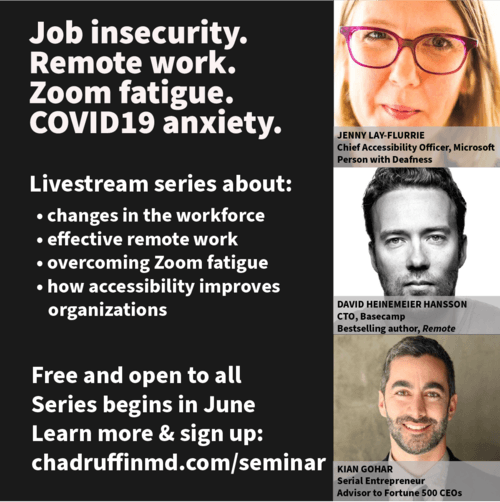
New Seminar Series: WFH, Quarantine Economy, & Using Accessibility to Proactively Change Organizations
Remote work. Zoom fatigue. Economic uncertainty. Anxiety? Sure, but this is the time for the deaf and hard of hearing to change work culture. Join us to learn how to take this opportunity to build better remote culture for better collaboration and less videoconferencing and meetings.
Read More →
Part 1 of COVID-19 for the Deaf/Hard of Hearing: How Hospitals Work
Have a plan in place before you get sick. Being prepared ahead of time is key. In an epidemic, the hospital can be overwhelming. You may be in a temporary isolation tent or placed in a hallway. You may not have access to communication tools that you usually get. Again, being prepared ahead of time is key. Make a plan with your family if you’re not ready.
Read More →
Part 2 of COVID-19 for the Deaf/Hard of Hearing: Communicating in the Hospital
In the hospital, COVID-19 creates unique challenges for those with hearing loss. COVID-19 patients are separated from other other patients into “respiratory isolation.” This means that masks and noisy air purifiers are widely used. Masks that muffle the voice and prevent lipreading. Unlike other medical settings, masks will not be lowered so that you can lipread.
Read More →